
Flat iron steak
A flat blade of finely marbled shoulder meat. The butcher removes the tough seam before cutting the steaks.
Sear in cast iron
Pat the flat iron dry and sear both broad faces in a hot, lightly oiled skillet. Rest it whole, then slice across the grain.
Chuck eye steak
Cut close to the rib, it has a small central eye with seams of fat between the surrounding muscles.
Grill over two heat zones
Brown the chuck eye over direct heat. Move it to the cooler side to finish if the fat starts to flare, then carve around the larger seams.
Ribeye
A curved seam of fat separates the cap from the central eye.
Pan-sear and render the fat
Hold the fatty edge against a hot skillet with tongs, then sear both faces in the rendered fat. Check the temperature in the central eye.
Tomahawk ribeye
The long, exposed rib bone is the giveaway. The meat is the same ribeye you’d find on a shorter bone.
Reverse-sear on the grill
Start this thick steak on the cooler side with the lid closed. Finish directly over the coals to brown both faces. Probe the eye clear of the long rib bone.
Filet mignon
This thick, round medallion is cut from the tenderloin. It’s boneless and has little visible fat.
Sear, then oven-finish
Brown both flat faces of the thick medallion in an ovenproof skillet. Finish in a 375°F oven, checking the center from the side with a thermometer.
Porterhouse
A strip and a generous filet share one T-shaped bone. Compare the filet side with the smaller one on a T-bone.
Grill over two heat zones
Sear both faces, then finish over gentler heat with the larger strip side toward the fire. Check both the strip and the filet before resting.
T-bone steak
The strip is on one side of the bone. The tenderloin on the other side is smaller than on a porterhouse.
Grill with the filet facing away from the heat
Brown the steak over direct heat. To finish, straddle the edge of the hot zone and point the small tenderloin toward the cooler side. Check both muscles.
New York strip
Cut the strip away from the bone and you get one long steak, often with a ribbon of fat along one edge.
Pan-sear on the fat edge first
Use tongs to stand the strip on its fat edge until it renders. Lay it flat and brown each side, then slice across the short width.
Top sirloin steak
A thick, lean cut with a firm grain and a narrow edge of fat.
Grill over direct heat
Lightly oil the lean surface and brown both faces over a hot grill. Finish thick steaks on the cooler side, then slice thinly across the grain.
Picanha
Also called sirloin cap or coulotte. Look for the thick band of fat curving over one side.
Render the cap in a skillet
Start the steak fat-side down in a cool skillet over medium heat. Once the cap is golden, sear the cut faces and finish over gentler heat.
Tri-tip roast
This tapered triangle comes from the bottom sirloin. It’s sold whole as a roast or sliced into steaks.
Roast whole, then sear
Mark where the grain changes direction before cooking. Roast over indirect heat, sear the outside over the fire, then divide at the turn and carve each half across its grain.
Eye of round steak
One round, lean muscle with very little marbling.
Braise gently in stock
Brown the medallions, soften sliced onions in the pan, then add stock partway up the meat. Cover and cook at a bare simmer until a fork slides in easily.
Top round steak
A broad, lean slice from the inside of the hind leg. It has a wider face than an eye of round.
Pound thin and pan-fry
Pound thin slices to an even thickness for cutlets. Dredge lightly in seasoned flour, then pan-fry in a shallow layer of oil until golden on both sides.
Brisket flat
A broad, tapered slab with a fat cap. This is a cut for slow cooking.
Braise covered, then slice
Brown the flat, set it on onions and add stock partway up its sides. Cover and cook in a 300°F oven until fork-tender. Slice across the grain and spoon the juices over it.
Skirt steak
A long, narrow strip with coarse fibers that run across its width.
Sear quickly over high heat
Cut the long strip into pieces that fit your skillet. Pat dry, sear in a very hot pan, then turn each piece so your knife cuts across the coarse fibers.
Plate short rib
In an English-cut short rib, a thick block of meat sits above a single piece of rib bone. Give it a slow braise.
Slow-braise on the bone
Brown the meaty faces, then nestle the ribs bone-side down in stock and aromatics. Cover and braise in a 300°F oven until the meat yields beside the bone.
Flank steak
A broad, flat cut with long fibers running from end to end.
Broil whole and slice thin
Note the direction of the long fibers, then broil on a rack, turning once to brown both sides. Rest and carve thinly across those fibers with the knife at a slight angle.
Cross-cut beef shank
A round marrow bone sits in the center of this braising cut.
Braise in a single layer
Brown both cut faces. Lay the rounds flat in a snug pot with stock partway up the sides. Cover and cook gently until the meat pulls apart and the marrow is soft.
Once you’ve chosen your cut, compare steak doneness by temperature.
Which way does the grain run?
Look at a raw flank steak and you can trace long lines from one end to the other. Those are muscle fibers. Before you season the meat, notice their direction. Once the surface browns, they’re harder to see.
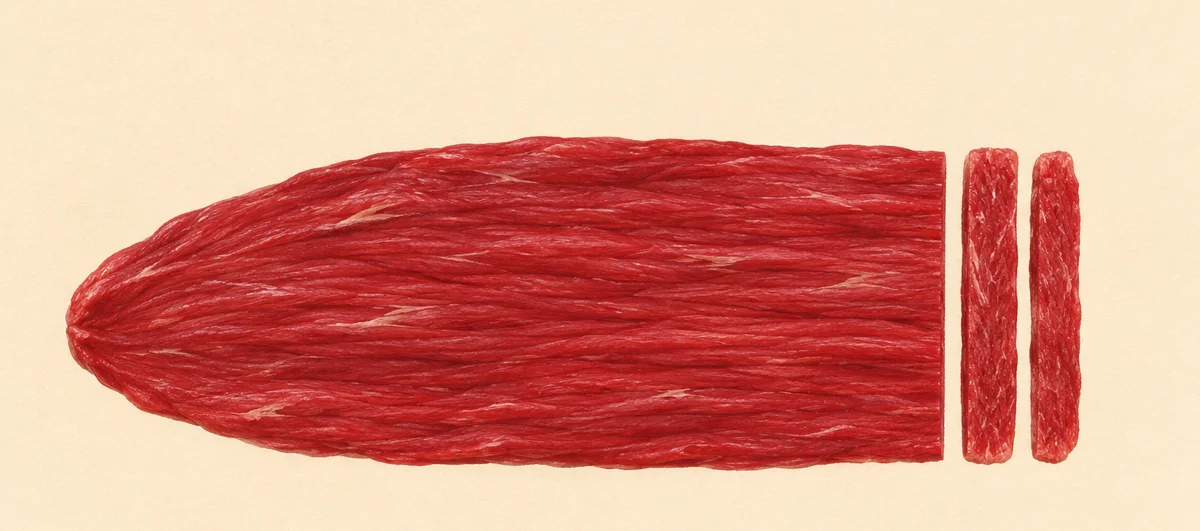
After resting the steak, lay it on the board with those lines running left to right. Cut from top to bottom. The knife crosses the fibers and shortens them, which gives each slice a more tender bite.
Two cuts need an extra turn. On a tri-tip, the grain changes direction partway through. Divide the roast there and rotate each piece before slicing. On a porterhouse, free the strip and filet from the bone first so you can carve each muscle across its own grain.
Sources
Tenderloin and filet mignon · How to identify a porterhouse · Kansas State University’s guide to beef cuts · Beef. It’s What’s For Dinner. on the short plate · Cow outline adapted from Ysangkok’s public-domain diagram
